Report I.
Report from the international conference on the study of occultism Tea at Mephisto’s
Author: Tomáš Kubisa
From 24 to 26 October 2025, the Mahen Memorial in Brno hosted the third edition of an international event dedicated to the study of occultism, hermetic traditions and related cultural phenomena – the conference Tea at Mephisto’s. This gathering, initiated by the Czech-Slovak research group Síť / Network, once again created a space for scholars, authors, students and all those interested in spiritual and esoteric topics. For three days, the historic premises of Mahen’s Villa transformed into a vibrant centre of interdisciplinary exchange between scholarship, art and spiritual experience.
Over the years, Tea at Mephisto’s has established itself as a unique platform that connects academic research on Western esotericism with its practical and artistic expressions. It continues the legacy of earlier projects – especially the Hermetismus conferences (Hussite Theological Faculty, Charles University) and the ongoing seminar Šťastná hodina (Happy Hour) – and contributes to shaping an increasingly active Czech-Slovak community devoted to the study of spiritual and occult cultures. The event is exceptional in its ability to bring together scholars of religion, historians and academics in general with artists and practitioners, creating a shared creative space where academic knowledge naturally meets lived practice and cultural interpretation.
This year’s edition offered an exceptionally rich programme – more than one hundred visitors attended over the three days, and more than twenty speakers, artists and exhibitors from five countries (the Czech Republic, Slovakia, Mexico, the United States and Austria) contributed to the programme. It featured over twenty scholarly presentations, a panel discussion, artistic performances and five exhibitions – three artistic and two academic – presented in three languages, giving the event a distinctly international character.
The Friday programme opened with the panel discussion The Occult Book in the 21st Century, which presented new trends in the creation of occult and esoteric literature. The panel featured Ivan Šebesta, Josef Szymeczek, Róbert Adamec, Veronika Šulcová and Jiří Schwarz, moderated by Petr Soukup, known for the podcast Tekutá krajina. The official opening of the conference followed, attended by the Dean of the Faculty of Arts at Masaryk University, Assoc. Prof. Irena Radová, who introduced the event with a symbolic “Homeromantic” divination. The opening lecture by Mgr. Jan Ševčík presented new findings in the study of Czech and Slovak occultism, focusing on regional differences in the historical context of Czechoslovakia in the first half of the 20th century.
The evening continued with the opening of five exhibitions – two scholarly, dedicated to practical alchemy and Pavel Langer’s tarot, and three artistic, featuring the works of Veronika Šulcová (embroidery), Lenka J. Táborská (painting) and Ksenia Alexeeva (graphics). The programme concluded with a social gathering accompanied by music and informal conversation.
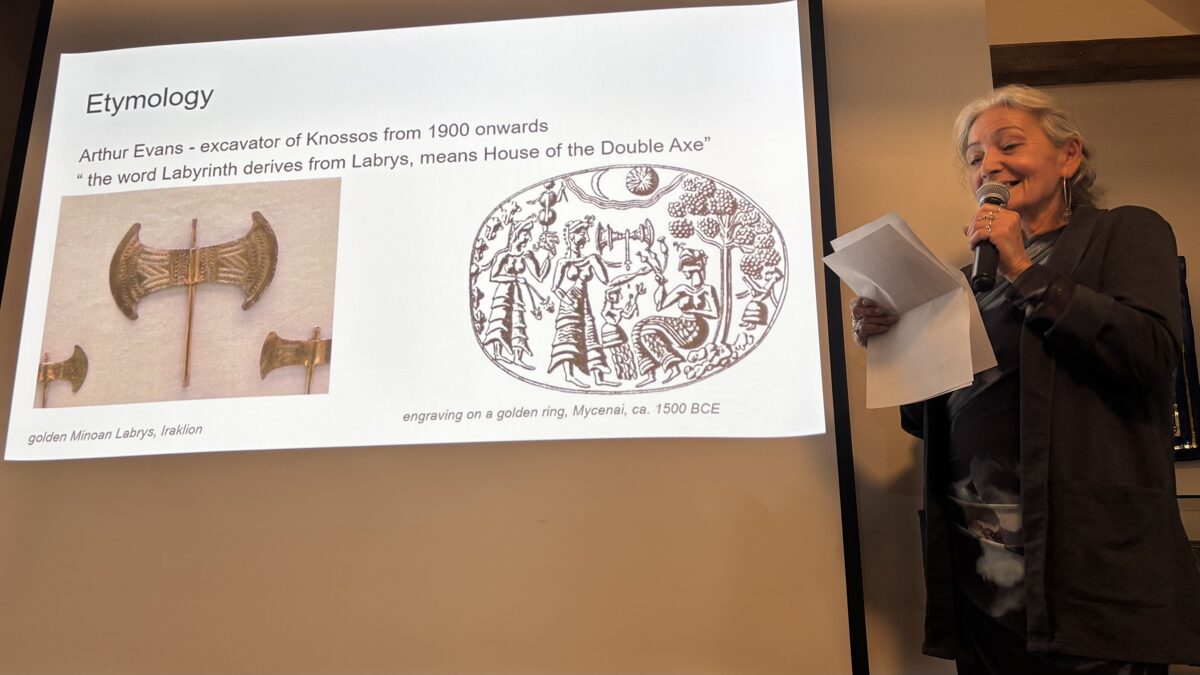
Saturday began with the traditional tea ceremony, followed by a block of Czech and Slovak lectures. Jan Krása introduced the history and symbolism of fire; Veronika Šulcová presented an interpretation of Haitian vévé; and Dr. Ivo Chmelař explored the hermetic views of Arturo Reghini. His lecture concluded with a dramatic demonstration of ritual practice. The afternoon English-language block offered international perspectives: John Meek discussed sacred space and its maintenance, archaeologist Marion Vrbicky explained the magical significance of the labyrinth, David Sater presented the manuscript as an alchemical technology and the symbolism of the alembic, Vanessa A. Portugal offered research on astrological symbols in New Spain, and Zuzana Hrášková connected cognitive science with spiritual understandings of ritual.
The evening programme featured hypnotist Jakub Kroulík, who continued the legacy of J. Hanussen and W. Messing, well-known 20th-century hypnotists and mentalists who often faced persecution by totalitarian regimes. This was followed by a performance by Lenka J. Táborská, a lecture by Dr. Lenka Příplatová on materialist magical thinking, and a contribution by Martin Sarkyr Král on supernatural horror in literature, presenting both well-known and lesser-known authors. The day concluded with a communal dinner.
Sunday morning again opened with a tea ceremony and continued with a series of lectures on the history of the Golden Dawn, the development of Thelemic spirituality and the activity of Freemasons during the Slovak State. Igor Kňazovický also discussed the role of Imrich Karvaš, while Tomáš Kubisa examined the use of mysticism in the propaganda of the Slovak Republic (1939–1945) and the fate of occultists under the communist dictatorship in the 1950s. In the afternoon, the audience enjoyed a dance performance by Jitka Senčuch and a series of talks on filmic, literary and mythological interpretations of occultism by Martin Jiroušek. Martin Kováč introduced a relatively little-known topic: the interpretation of Greek mythology through the hermetic lens of the Russian tradition associated with Evgeny Golovin. The programme ended with an introduction to the sefirotic Kabbalah by Zuzana Antares.
The ceremonial closing, accompanied by the singing of Kristýna Pernicová, provided a symbolic conclusion to the three-day programme, which intertwined scholarly research, artistic expression and spiritual experience. The organising team considers the 2025 edition highly successful – thanks to the high quality of contributions, excellent cooperation among participants and a welcoming atmosphere. Edited recordings of the lectures will be made available on YouTube.
Report II.
The Third Tea
This year, on 24–26 October 2025, another edition of Tea at Mephisto’s took place.
Thanks to the commitment of the team, we spent over half a year meeting for planning sessions and fine-tuning details. And then it happened.
Tea at Mephisto’s has a very special atmosphere. The programme does not only offer scholarly blocks and panel discussions. This year it also included three art exhibitions,
five artistic performances, a book bazaar and a ritual swap, and many other elements.
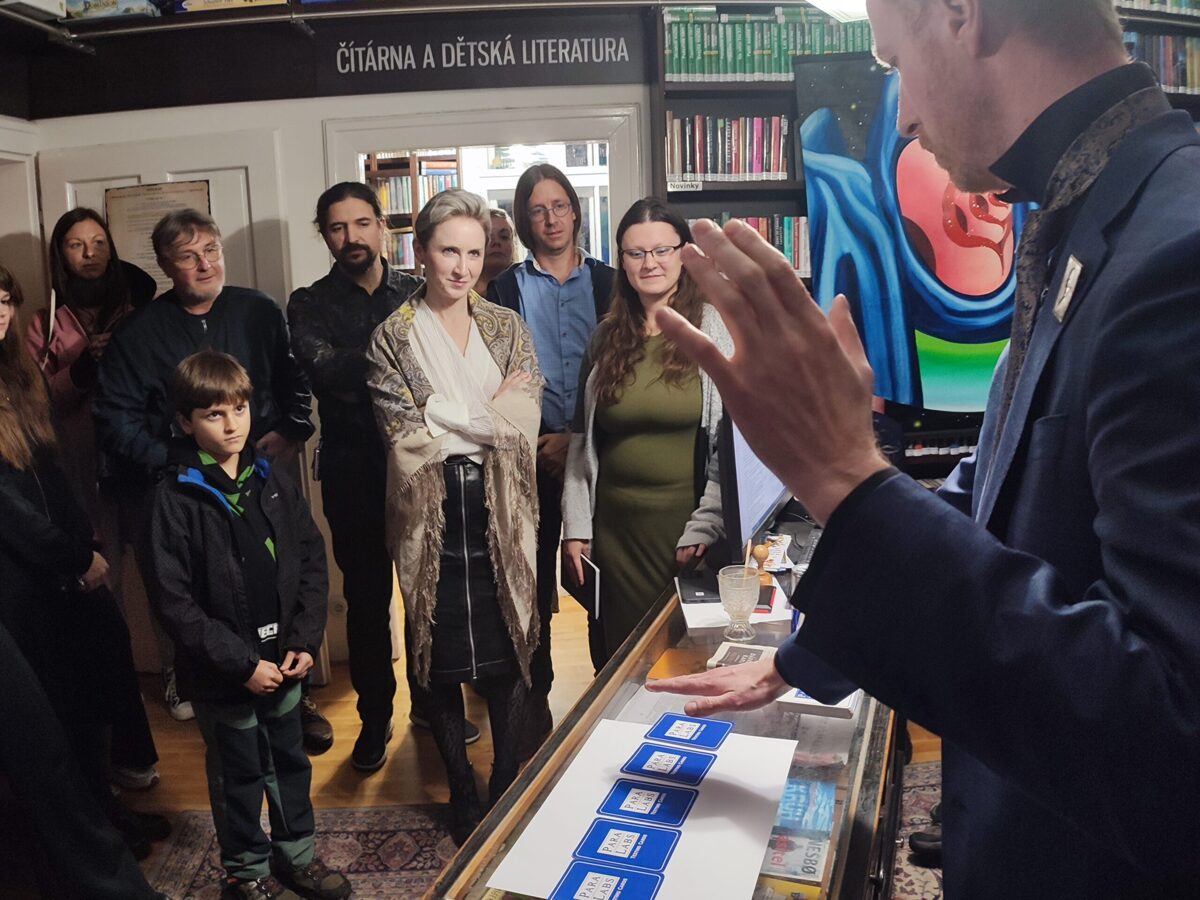
Friday’s programme began with a lecture on the research of Czecho-Slovak occultism, followed by a tour of the Mahen Memorial, exhibition openings and a concert.
On Saturday, there was a tea ceremony, a block dedicated to the history of the spark, symbolism and the dream world, and a lecture on the Occult Empire with a practical demonstration.
The international block brought dance performances, topics of sacred space, labyrinths and astrology. The evening featured a hypnotist and lectures on cognitive magic and supernatural horror in literature.
Sunday offered topics of Thelema, Freemasonry, Slavic mysticism, a fan dance and a lecture on occult cinema.
I would like to thank everyone involved for a wonderful time. I am already looking forward to the next edition.
>Report III.
Tea at Mephisto’s 3: A meeting of scholars, magicians and artists in Mahen’s Villa
Excerpt: From 24 to 26 October 2025, the third edition of the international conference
Tea at Mephisto’s, focused on occultism, esoteric traditions
and their cultural and historical contexts, was held in Brno at the initiative
of the Czech-Slovak research society Síť. The premises of the Mahen Memorial
– the villa where Antonín Vančura, poet, journalist, dramaturg,
librarian and man of countless pseudonyms, the best known of which is
the name Jiří Mahen, lived and worked – were transformed for three days into
a place where scholarship, magic and art meet. This volunteer-organised event
once again retained its distinctive, almost festival-like atmosphere, while at the same time offering a wealth of stimulating material...
You can read the full report in the Czech language >here< 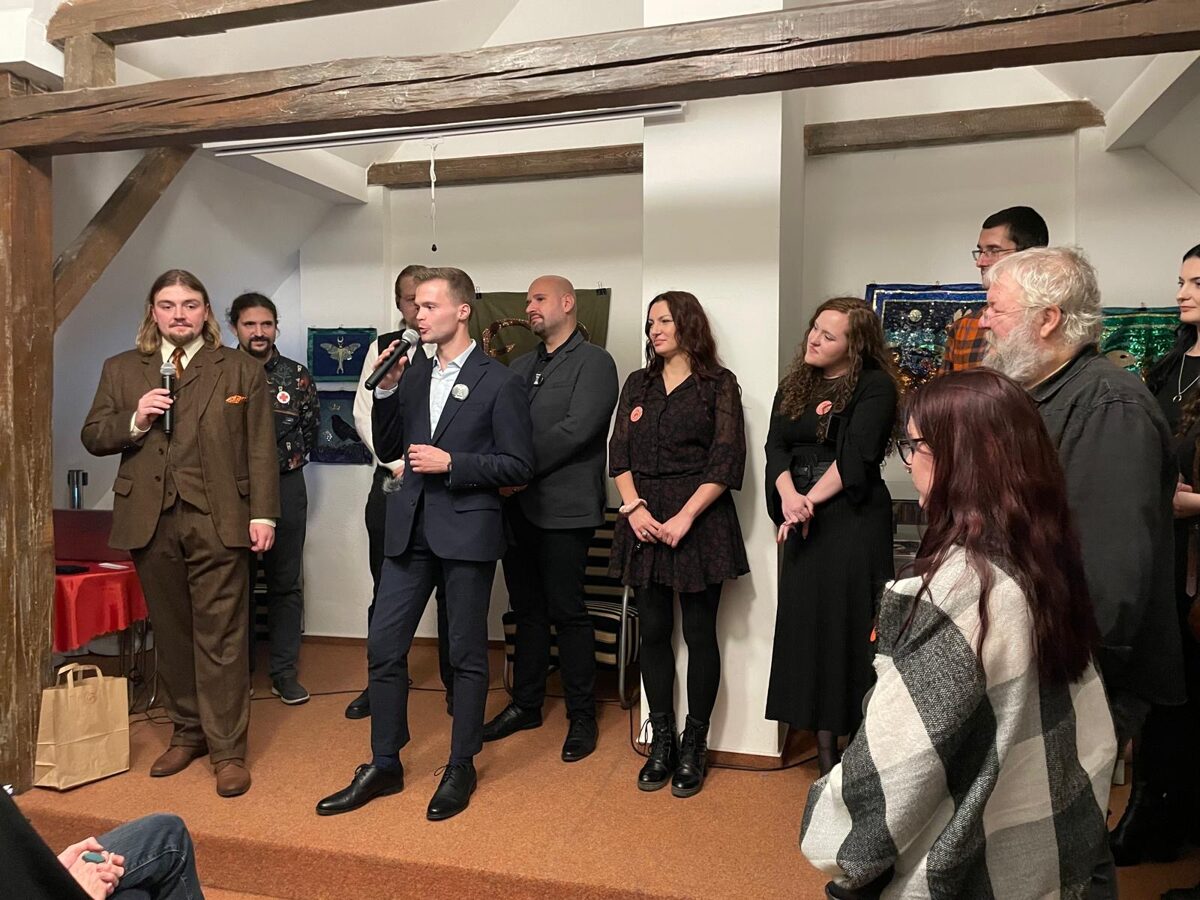
 Archive of Reports